
(Age Group: 24-Month-Old Toddlers)
By Manjot Kaur, Sarbjit Kaur, and Lina Esfahani
Currently our toddler room is exploring the art of story telling. What started as an open ended provocation paired with educators who allowed children to have an active voice in their learning turned into a learning experience where objects acted as bridges between imagination and reality, helping children anchor their ideas, revisit memories, and confidently participate in shared narratives.
Our story began as children entered the space, they were immediately drawn to the animal figurines.The educators had known that the children were interested in animals but were curious about what they knew about the animals. Many carefully picked up an animal and flipped through the books, scanning the pages with focus and excitement. They began matching animals to pictures, pointing and comparing with intention. Smiles spread across their faces as they recognized familiar creatures, and some laughed and clapped when they found a match.
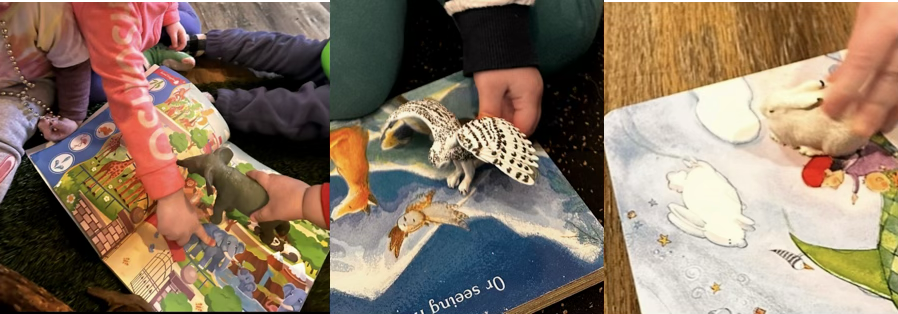
We heard:
“I found it!”
“Here! Same one!”
Children repeatedly returned to the books, turning pages back and forth, strengthening their visual recognition and memory. Educators thoughtfully extended their thinking by asking:
“Where is the elephant?”
“Can you find it in the book?”
“What animal is next?”
This growing interest naturally flowed into our morning assembly. When asked what stories they wanted to hear, children eagerly called out animal names:
“Elephant!”
“Ant!”
“Dragon!”
“Dinosaur!”
Educators created spontaneous stories that included their chosen animals. Later, during reflection time, many children confidently retold the same stories, recalling details with accuracy and pride. Some even began inventing their own versions, adding new
characters and creative ideas.
What We Noticed
- Repeated matching between objects and images
- Sustained focus and concentration
- Joyful emotional responses (clapping, laughing, smiling)
- Increasing vocabulary
- Story recall and sequencing
- Emerging imaginative storytelling
- Children revisiting the experience throughout the day
Shifts in engagement became visible as children moved from matching → naming → listening → retelling → creating their own stories.
This experience highlighted how children use play, objects, and books to construct meaning in meaningful ways. Matching the animals revealed early literacy skills, classification, and visual discrimination.
Retelling stories demonstrated memory, comprehension, and growing confidence with language. Creating their own stories reflected imagination and symbolic thinking. This experience revealed that children are capable narrators when given familiar and meaningful materials.
The educators were curious alongside the children who appeared to be theorizing about animal identities and characteristics, connections between real objects and representations and story structure
Where We Went Next
During the morning assembly, the dragon story unfolded exactly as co-constructed:
Educator: “Once upon a time there was a”
Child: “Princess”
Educator: “Princess name was”
Child: “Cinderella”
Educator: “Princess lived”
Child: “Castle”
Educator: “Princess lived on the very top of a mountain. And one day she woke up and opened her room curtain, and she saw everything was white outside because there was a snowstorm last night. But the princess had to go outside, so she started getting ready. She put her snow boots on, hat, mittens, and her winter jacket. But when she was walking outside, she saw there were some big footprints outside. They were really huge, and they didn’t look like human footprints.”
Child: “That’s dragon.”
Educator: “Ohhhhhh, let’s see if it’s really a dragon or not.” “Then the princess started following those footprints, and she reached in the jungle where she saw some”
Child: “Elephants.”
Educator: “The princess asked the elephants, ‘Hey elephants, are these your footprints?’ The elephants said, ‘No Cinderella, those are not our footprints.’ The princess started walking again, and she reached in the middle of the jungle where she heard some sound coming from behind the bushes, and when she saw it, it was a aaaaaaa”
Child: “Dragon!” (with laughter and excitement)
Educator: “But Cinderella was so scared of dragons, so she screamed. The dragon woke up from his sleep, and the dragon got mad. He opened his mouth and”
Child: “Blowed some fire.”
Educator: “And trees caught fire in the jungle, and Cinderella needed some help to stop the fire. Who can help Cinderella?” Child: “Elephants.”
“Cinderella called the elephants, and they filled water in their trunks (as discussed in the morning assembly), and they sprayed water, and there was no fire in the jungle.”
Children: “Yaaahhhhhh!” (clapping)
The story concluded with helping each other and respecting everyone’s space. The children proudly celebrated the solution together.
After this shared storytelling experience, we continued nurturing their interest during reflection meetings. The children began sharing their own stories in the morning assembly:
Child A: “Once upon a time there was a big, big froggie.” Child B: “Little froggie.”
Child A: “Ribbit ribbit. In the house.”
Educator: “Who’s in the house?”
Child: “Frogie.”
Educator: “What colour is your froggie?”
Child: “Green froggie.”
Child A: “Snow outside house. I help froggie.”
Child C: “Frogie play snow.”
Educator: “How did you help froggie?”
Child: “I scared him.”
Educator: “Why were you scared of froggie?”
Child: “I help froggie.”
Then he stood up, held one of his peer’s hands, helped her stand up, and started walking slowly. He looked at the educator. Educator: “Is this the way you helped froggie?”
Child: “Yes.”
The educator celebrated this meaningful moment by clapping and singing a froggie song with the children, reinforcing connection and empathy.
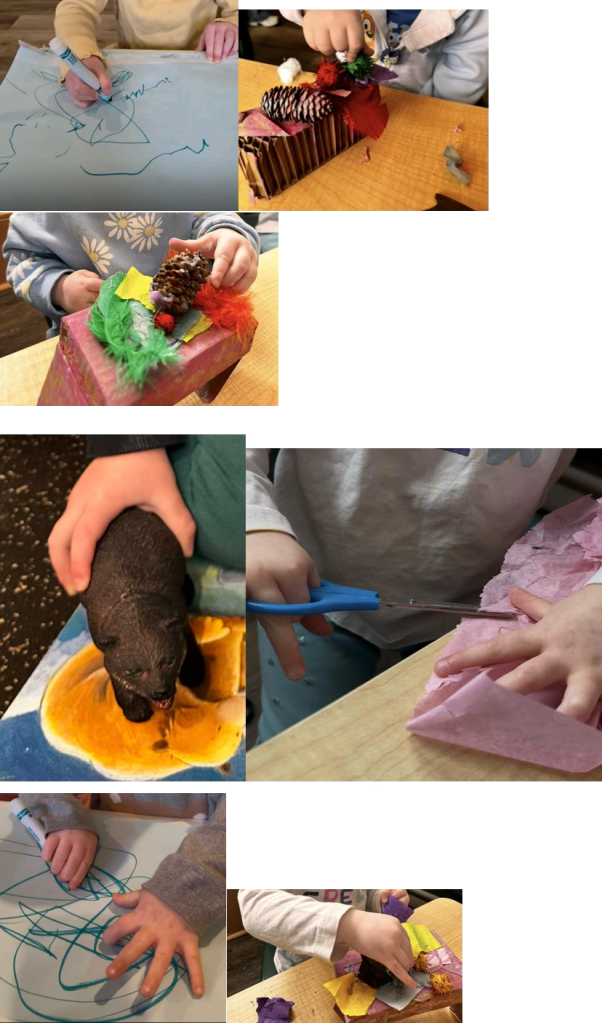
The storytelling further extended into art experiences. During art and crafts, children named their creations from the stories: princess castle, dragon, froggie. When educators asked, “What are we making?” they replied, “Dinosaur,” “Elephant,” and other animal names from the stories. At first, their drawings were only a line or two. As they observed the animals more closely, their representations gradually became more detailed. Educators asked, “What else can go on their bodies?” and children responded, “Eyes,” “Tail,” “Ears,” “Mouth,” carefully adding those features with growing intention.
Throughout this entire experience, children moved from matching animals to naming them, from listening to stories to retelling and eventually creating their own. The use of real objects as representations played a powerful role in bringing storytelling to life for the children. Holding the animal figurines allowed stories to move beyond words and become tangible, visible, and deeply meaningful experiences that promoted imagination, empathy, cooperation, confidence, and emotional expression. Using tangible objects allowed the children’s learning to become deeply visible through their voices and actions.
 allegrochildcare.ca